Family and Juvenile Court Improvement Program (FJCIP)

The mission of the FJCIP Statewide Team is to expand the capacity of local FJCIP court communities to transform systems and produce better outcomes for children and families. We strive to foster learning communities across systems to create a culture of system change within the state of Washington.
Watch a highlight video of the program here! Family and Juvenile Court Improvement Program (FJCIP) Core Component Video Clip (youtube.com)
A network of courts that work collaboratively across systems to develop and assess the effectiveness of local innovations, translating what works into statewide programs to improve outcomes for all families.
- Innovation & Continuous learning
- Accountability
- Equity/Cultural Humility
- Communities & Families
- Inclusion & Representation
- Sustainability
- Leadership/Empowerment/Integrity
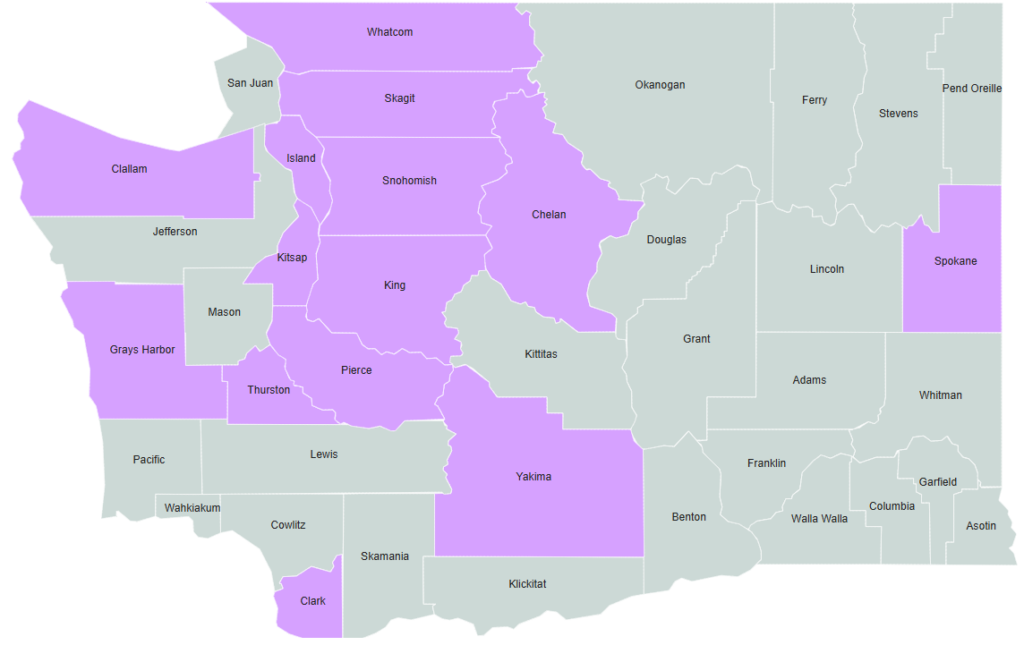
FJCIP Operates in 14 Counties
The state provides FJCIP funding to support fourteen Superior Courts (highlighted in purple) in implementing enhancements to their family and juvenile court operations!
Each participating court has a dedicated FJCIP Coordinator who facilitates system improvement efforts and supports system learning by gathering and analyzing data which is shared with local dependency stakeholder groups. FJCIP has proven to be an excellent laboratory for innovative ideas and implementation of practices.

FJCIP Implementation Framework
Click the image on the left to view the interactive Implementation Framework graphic and learn more about the different components of the FJCIP. Download a PDF of the image using the link below.
Family and Juvenile Court Improvement Program Framework -2024
Family & Juvenile Court Improvement Program Implementation Framework Video
Core Components
The critical parts of the FJCIP model are depicted as Core Components of the program.
There are eight core components. These components form the foundation for the FJCIP, providing the framework for assessing and evaluating the overall model’s effectiveness.
The success of FJCIP courts is directly related to the leadership provided by dependency court judicial officers. Judicial officers lead the formation of a FJCIP court team that engages the local community in ongoing work of court communities for developing and maintaining programs that serve children and their families. Specialized training and experience help guide the judicial officer’s leadership within the court.
Training & Technical Assistance for Dependency Court Judicial Officers Infographic
The FJCIP court team supports and promotes ongoing, cross-system learning opportunities. FJCIP dependency judicial officers participate in specialized judicial training and in educational events with local system partners. In collaboration with court partners, the FJCIP creates a learning environment to engage the local system in acquiring new skills and changing practice with the goal of improving outcomes for children, families and the professionals who support them.
The FJCIP Coordinator is dedicated to improving dependency court operations and case outcomes for children and families involved in child welfare. Using data, research, and the experience of peer courts across the state, local FJCIP Coordinators work closely with their judicial officers to convene local system partners to identify opportunities for improvement, undertake meaningful practice change, and assess the effectiveness of their efforts. The FJCIP Coordinator works with court and system leaders to foster a court culture that is trauma-responsive, equitable and respectful of families, community members and system professionals. The coordinator actively participates in trainings, state-wide communities of practice, and state-wide system change efforts, to expand their job specific knowledge and skillset and contribute to a state-level knowledge base.
The FJCIP court team and court partners work together to ensure that accurate data informs the work of cross-system efforts that assess the court’s performance and identify priorities for improvement. This includes soliciting feedback from families served by the system. The FJCIP Coordinator has primary responsibility for facilitating cross-system workgroups, collecting and sharing data and monitoring the effectiveness of court improvement projects. This enables court partners to actively participate in and contribute to system improvement work. FJCIP courts can request CQI training and technical assistance from the AOC’s Statewide FJCIP Team and the Family & Youth Justice Programs.
FJCIP coordinators participate in a regular Community of Practice, facilitated by the Statewide FJCIP Team from the Administrative Office of the Courts (AOC), to learn from each other, share best practices and innovative ideas, ask questions, and work together toward continuous quality improvement. Regular Community of Practice meetings enable the coordinators to stay informed about the Department of Children, Youth and Families (DCYF), court, legislative and case law updates, and provide the AOC with insight into the needs of local courts. The Statewide FJCIP Team also helps to evaluate what works and share it with other courts and audiences.
Cross system collaboration builds constructive working relationships with all parties involved in the child welfare system (e.g., child advocates, DCYF case workers, lived experts, service providers, etc.). This collaboration enhances a community’s ability to improve the court system and the outcomes for children, families, and professionals. By engaging cross system partners in multi-level cross system work to find strategies for high level system improvement, they can connect youth and families with community resources.
An overarching goal of the FJCIP is to research, develop and implement strategies and approaches that yield statewide benefit. Through partnership with different workgroups and communication with the legislature, the FJCIP is building and sharing effective, data-driven solutions with other specialty courts and court programs in the state. This information exchange enables AOC staff to bring local court perspectives into statewide decision-making spaces and impact policy decisions.
The FJCIP recognizes that families who become involved with the dependency system have experienced significant trauma and adversity in their lives. FJCIP communities are educated about what it means to be a trauma-responsive system and the role of each member in creating a safe and healing environment for the children, youth and families they serve. FJCIP communities engage people with lived experience to improve local research, programs and practices. FJCIP continuously assess their effectiveness and take steps to better serve our families and children.
FJCIP County Work
Chelan County
Chelan County FJCIP Court Team:
- FJCIP Chief Judicial Officer: Judge Kristin Ferrera
- Additional Dependency Judicial Officer: Commissioner Tracy Brandt
- Administrator: Fona Sugg
- FJCIP Coordinator: Fona Sugg
- Court Contract Manager: Fona Sugg
Clallam County
Clallam County FJCIP Court Team:
- FJCIP Chief Judicial Officer: Judge Elizabeth Stanley
- Additional Dependency Judicial Officer: Commissioner Lorraine Rimson
- Administrator: Lacey Halberg
- FJCIP Coordinator: Christine Sportsman
- Court Contract Manager: Lacey Halberg
Clark County
Clark County FJCIP Court Team:
- FJCIP Chief Judicial Officer: Commissioner Stefanie Ellis
- Additional Dependency Judicial Officer: Judge Gregory Gonzales
- Administrator: Pam Hartman Beyer
- FJCIP Coordinator: Julie Christian
- Court Contract Manager: Whitney Freese
Grays Harbor County
Grays Harbor County FJCIP Court Team:
- FJCIP Chief Judicial Officer: Commissioner Jon Beltran
- Additional Dependency Judicial Officers: Judge Steve Jackson, Judge Katie Svoboda, Judge Vini Samuel
- Administrator: Josh Sedy
- FJCIP Coordinator: Laura Jones
- Court Contract Manager: Josh Sedy
Island County
Island County FJCIP Court Team:
- FJCIP Chief Judicial Officer: Judge Carolyn Cliff
- Additional Dependency Judicial Officer: Commissioner Scott Wessel-Estes
- Administrator: Megan Frazier
- FJCIP Coordinator: Kathryn Reid
- Court Contract Manager: Maria Hazelo
King County
King County FJCIP Court Team:
- FJCIP Chief Judicial Officer: Judge Janet Helson
- Additional Dependency Judicial Officers: Judge Coreen Wilson, Judge Adrienne McCoy, Judge Kristin Richardson, Judge Samuel Chung
- Administrator: Melinda Johnson-Taylor
- FJCIP Coordinator: Stacy Keen
- Court Contract Manager: Steve Davis
Pierce County
Pierce County FJCIP Court Team:
- FJCIP Chief Judicial Officer: Judge Clarence Henderson Jr.
- Additional Dependency Judicial Officers: Judge Diana Kiesel, Commissioner Ingrid McLeod
- Administrators: TJ Bohl, Buffy Via
- FJCIP Coordinator: Harper Sherman
- Court Contract Manager: Stacey Killmer
Skagit County
Skagit County FJCIP Court Team:
- FJCIP Chief Judicial Officer: Judge Heather Shand
- Additional Dependency Judicial Officer: Judge Brian Stiles
- Administrator: Rosanna Wadkins
- FJCIP Coordinator: Vacant
- Court Contract Manager: Rosanna Wadkins
Snohomish County
Snohomish County FJCIP Court Team:
- FJCIP Chief Judicial Officer: Judge Edirin Okoloko
- Additional Dependency Judicial Officer:
- Administrators: Christine Liebsack, Chad Watson
- FJCIP Coordinator: Cat Jackson
- Court Contract Manager:
Spokane County
Spokane County FJCIP Court Team:
- FJCIP Chief Judicial Officer: Judge Jeremy Schmidt
- Additional Dependency Judicial Officers: Commissioner Michelle Ressa, Commissioner Anthony Rugel, Commissioner Keven Stewart, Commissioner Julia Pelc, Commissioner Nichole Swennumson
- Administrator: Ashley Callan
- FJCIP Coordinator: Hannah Leckner
- Court Contract Manager: Leanne Wakefield
Thurston County
Thurston County FJCIP Court Team:
- FJCIP Chief Judicial Officer: Judge Indu Thomas
- Additional Dependency Judicial Officer: Judge Sharonda Amamilo
- Administrator: Kristin Jensen
- FJCIP Coordinator: Harmony Westcott
- Court Contract Manager: Kristin Jensen
Whatcom County
Whatcom County FJCIP Court Team:
- FJCIP Chief Judicial Officer: Commissioner Richardson
- Additional Dependency Judicial Officer: Judge Olson
- Administrator: Stephanie Kraft
- FJCIP Coordinator: Gloria Garcia
- Court Contract Manager: Stephanie Kraft
Yakima County
Yakima County FJCIP Court Team:
- FJCIP Chief Judicial Officer: Commissioner Sarah Flory
- Additional Dependency Judicial Officer:
- Administrator: Candi Shute
- FJCIP Coordinator: Elizabeth (Liz) Wangler
- Court Contract Manager: Courtney Melone