
Training, E-Learning & Events
Discover live events, recorded webinars, on-demand e-learning and tailored training opportunities designed to transform systems to promote thriving families and equitable court communities.
Click the tabs below to explore the different training opportunities available through Family & Youth Justice Programs.
Services and Supports: Part 2
November 17, 2026 | 12:00 – 1:15pm | Virtual via Zoom
Part 3 of the 7-Part Training Series on Early Childhood in Child Welfare Dependency Cases
Safe Feeding and Sleep
December 8, 2026 | 12:00 – 1:15pm | Virtual via Zoom
Part 4 of the 7-Part Training Series on Early Childhood in Child Welfare Dependency Cases
Harm of Removal with Young Children
January 13, 2027 | 12:00 – 1:15pm | Virtual via Zoom
Part 5 of the 7-Part Training Series on Early Childhood in Child Welfare Dependency Cases
Zero to Five Vulnerabilities
February 10th, 2027 | 12:00 – 1:15pm | Virtual via Zoom
Part 6 of the 7-Part Training Series on Early Childhood in Child Welfare Dependency Cases
Family Time with Young Children
March 10th, 2027 | 12:00 – 1:15pm | Virtual via Zoom
Part 7 of the 7-Part Training Series on Early Childhood in Child Welfare Dependency Cases
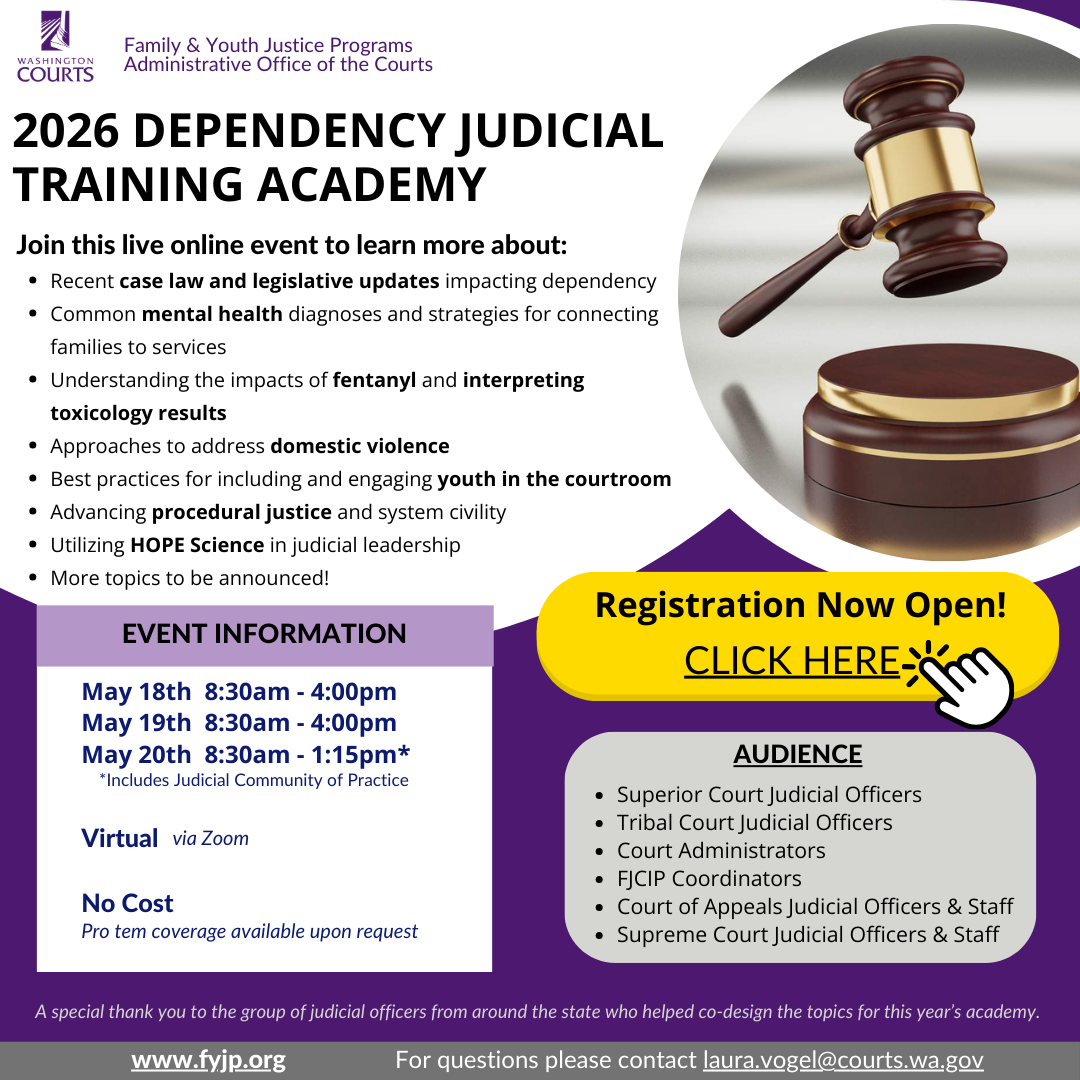
2027 Dependency Judicial Training Academy
May 17th – 19th, 2027 | Virtual via Zoom
Every year, FYJP hosts a multi‑day conference for judicial officers hearing dependency cases. The program is co‑designed with judicial officers who work in dependency courts, ensuring that the material is both practical and grounded in real-world needs. Sessions highlight the most current and relevant issues impacting child welfare today. For 2027, the academy will have an overall focus on permanency, with additional details to be provided as the event approaches.
Open to: Superior Court Judicial Officers; Tribal Court Judicial Officers; Court Administrators; FJCIP Coordinators. Judicial Officers, Commissioners, Law Clerks, Staff Attorneys and Externs from the Washington Court of Appeals and Washington Supreme Court are also welcome to attend.


Safety Summits
The goal of this cross-system training is to help local dependency court systems enhance child safety practice by using a common framework for talking about child safety. When all court and system partners utilize a shared understanding and language to clearly and consistently articulate safety-related information, including the harms of removal, the court can engage parties in meaningful inquiries in ways that support improved outcomes for children.
Available for individual WA counties as a multi-disciplinary training.
Length: 4 hours;
Format: Virtual via Zoom
Communities of Practice are collaborative groups of professionals who share a common concern, a set of problems, or an interest in a topic. These groups meet on an ongoing basis and focus on sharing best practices and creating new knowledge to advance a specific domain of professional practice (e.g., judicial practice). By fostering collaboration and continuous learning in a virtual environment, FYJP’s Communities of Practice enhance the effectiveness of professionals and systems, ultimately improving outcomes for children and families. Below are the Communities of Practices that FYJP facilitates.
Judicial Community of Practice
Monthly | 3rd Wednesday | 12:15 – 1:15 pm
The Judicial Community of Practice (JCoP) is a monthly, virtual peer-learning opportunity for judicial officers who hear child dependency cases.
Statewide Hope Science Community of Practice
Monthly | 2nd Wednesday | 12:00 – 1:00 pm
The Statewide Science of Hope Community of Practice is an informal, collaborative learning space used to solve problems and innovate.
Family Juvenile Court Improvement Program Community of Practice
Monthly | 1st Tuesday | 11:00 am – 12:30 pm
The Family Juvenile Court Improvement Program (FJCIP) Community of Practice is a space for FJCIP Coordinators to come together, learn from each other, and with each other.
To learn more, contact Rosalynn Guillen at rosalynn.guillen@courts.wa.gov
Family Treatment Court Community of Practice
Monthly | 4th Tuesday | 11:00 am – 12:00 pm
The Family Treatment Court (FTC) Community of Practice offers coordinators and other FTC members an opportunity to improve their skills, share ideas, and help shape effective practices within their communities.
Early Childhood Court Community of Practice
Monthly | 4th Tuesday | 9:00 am – 11:00 am
The Early Childhood Court (ECC) Community of Practice is an opportunity for ECC coordinators to strengthen their expertise, share innovative strategies, and collaborate on advancing effective, family-centered practices in their communities.
Dependency 101 for Judicial Officers
Dependency 101 for Judicial Officers is designed to facilitate the delivery of quality, interactive, on-demand virtual trainings that examine the information, practices, and skills judicial officers need to effectively preside over child abuse and neglect cases in Washington State. These courses examine the essential principles of dependency court systems and judicial decision-making that ensure safety, due process, timeliness, permanency, and well-being for children and families.
Dependency 201 for Judicial Officers
Dependency 201 for Judicial Officers is designed as the next step for judicial officers who have completed Dependency 101 or who are seeking deeper engagement with the complexities of child abuse and neglect cases in Washington State. These interactive, on-demand courses explore advanced topics in dependency law and practice. They build on foundational knowledge to strengthen judicial officers’ skills in balancing competing interests, analyzing complex case dynamics, and ensuring decisions are legally sound, trauma-informed, and responsive to the needs of children and families
Safety Snapshots Mini-Series
This mini-learning series contains short training, practice, and knowledge test activities that are all centered around the effective application of the Safety Framework into dependency court system practice.
FJCIP Data Training Modules
This series of training modules was created for FJCIP Coordinators to increase data capacity in dependency courts.
Family Treatment Courts Best Practice Standards Training
This series of training modules are based of the Family Treatment Court Best Practice Standard Published in 2019. These best practices were developed using current research and practices in the field as determined by a team of experts from across fields of Child Welfare, Substance Use Disorder Treatment, Drug Court, and Dependency Best Practices.
Early Childhood Courts Judicial Training
This collection of recorded training sessions from the Children’s Bureau’s Child Welfare Capacity Building Collaborative, Zero to Three, and National Council of Juvenile and Family Court Judges focus on primary skills and knowledge that judicial officers would need to effectively preside over a specialty Early Childhood Court.
Video playlists are organized collections of related videos grouped together for easy viewing. They allow users to access multiple videos on a specific topic in one place, creating a structured learning experience. Playlists help streamline content, making it simple to follow a series of sessions, explore different perspectives, or dive deeper into a subject without searching for individual videos.