Skip to content

Training, E-Learning & Events

Discover live events, recorded webinars, on-demand e-learning and tailored training opportunities designed to transform systems to promote thriving families and equitable court communities.

Click the tabs below to explore the different training opportunities available through Family & Youth Justice Programs.

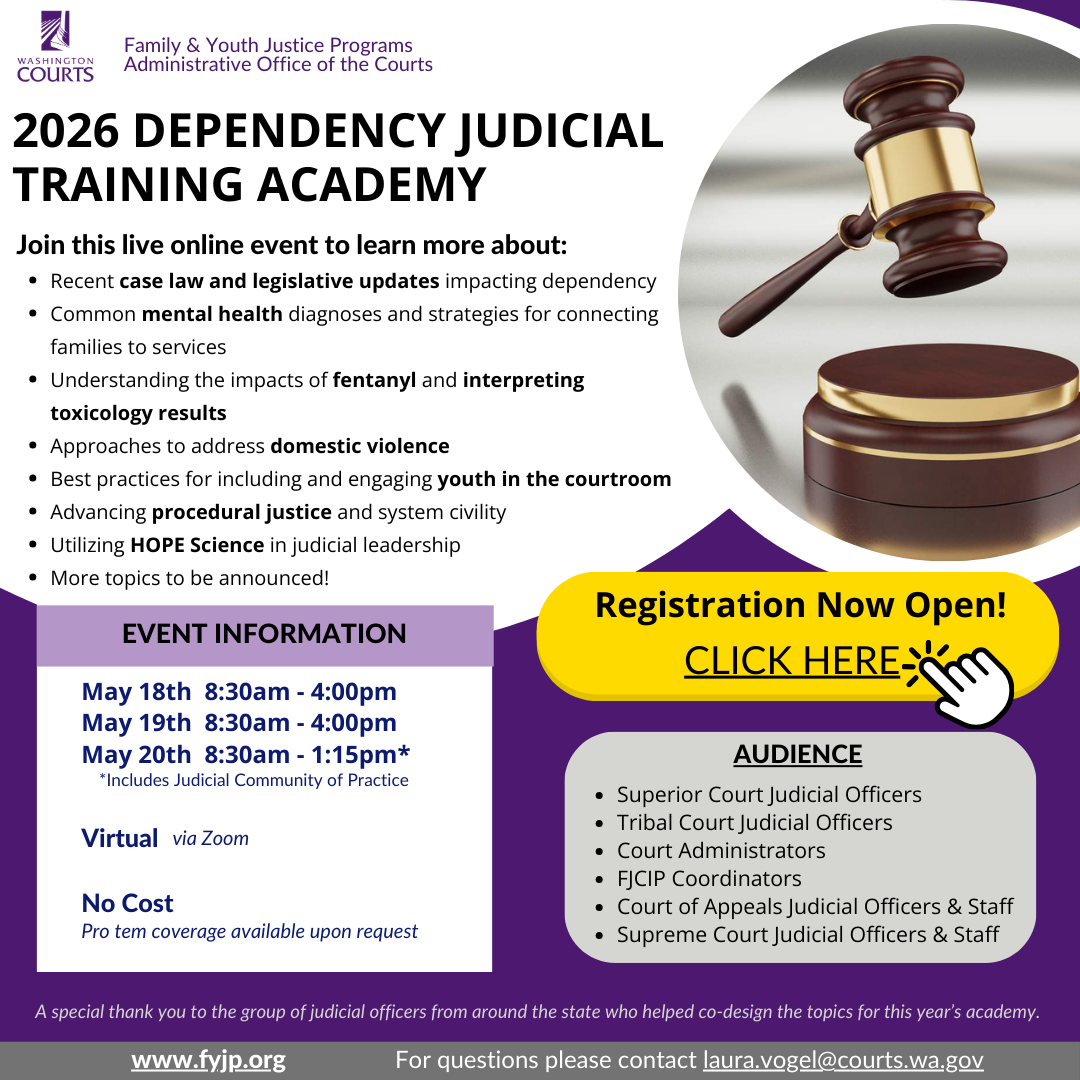
2026 Dependency Judicial Training Academy

May 18th – 20th   |   Virtual    

The 2026 Dependency Judicial Training Academy is designed to strengthen judicial and court capacity to meet these challenges and improve outcomes for children, youth, and families. Recent developments in case law and legislative updates are shaping practices in dependency cases, requiring professionals to stay informed and adaptable. Key areas of focus include understanding common mental health diagnoses and implementing effective strategies to connect families with appropriate services, as well as addressing the growing impact of fentanyl, including safety planning and utilization of Medication for Opioid Use Disorder (MOUD). The academy will also cover approaches to addressing domestic violence, best practices for including and engaging youth in the courtroom, and advancing procedural justice and system civility. Additionally, judicial leadership is increasingly incorporating HOPE Science to foster positive outcomes and strengthen trust within the system.

Registration is open to: Superior Court Judicial Officers, Tribal Court Judicial Officers, Court Administrators, FJCIP Coordinators, Judicial Officers, Commissioners, Staff Attorneys and Externs from the Washington Court of Appeals and Washington Supreme Court are welcome to attend.


Whatcom County Safety Summit

April 24th   |   9:00am – 4:00pm   |    Bellingham Yacht Club

The Safety Summit is ideal for Whatcom County Dependency Court professionals and system partners involved in any aspect of child safety. Attendees can anticipate learning common language about child safety, contributing to their local community court system improvement, and engaging in meaningful peer-to-peer networking.

2026 Dependency Judicial Training Academy

2025 Dependency Judicial Training Academy

2024 Dependency Judicial Training Academy

2023 Dependency Judicial Training Academy

2022 WA Judicial Training Academy on Reasonable and Active Efforts

2021 Judicial Academy on Reimagining Justice in Child Welfare and Dependency Court

2020 Judicial Training for State and Tribal Judicial Officers

Safety Summits

The goal of this cross-system training is to help local dependency court systems enhance child safety practice by using a common framework for talking about child safety. When all court and system partners utilize a shared understanding and language to clearly and consistently articulate safety-related information, including the harms of removal, the court can engage parties in meaningful inquiries in ways that support improved outcomes for children.

Available for individual WA counties as a multi-disciplinary training.

Length: 4 hours;

Format: Virtual via Zoom

Communities of Practice are collaborative groups of professionals who share a common concern, a set of problems, or an interest in a topic. These groups meet on an ongoing basis and focus on sharing best practices and creating new knowledge to advance a specific domain of professional practice (e.g., judicial practice). By fostering collaboration and continuous learning in a virtual environment, FYJP’s Communities of Practice enhance the effectiveness of professionals and systems, ultimately improving outcomes for children and families. Below are the Communities of Practices that FYJP facilitates.

Judicial Community of Practice

Monthly | 3rd Wednesday | 12:15 – 1:15 pm

The Judicial Community of Practice (JCoP) is a monthly, virtual peer-learning opportunity for judicial officers who hear child dependency cases.

Statewide Hope Science Community of Practice

Monthly | 2nd Wednesday | 12:00 – 1:00 pm

The Statewide Science of Hope Community of Practice is an informal, collaborative learning space used to solve problems and innovate.

Family Juvenile Court Improvement Program Community of Practice

Monthly | 1st Tuesday | 11:00 am – 12:30 pm

The Family Juvenile Court Improvement Program (FJCIP) Community of Practice is a space for FJCIP Coordinators to come together, learn from each other, and with each other.

To learn more, contact Rosalynn Guillen at rosalynn.guillen@courts.wa.gov 

Family Treatment Court Community of Practice

Monthly | 4th Tuesday | 11:00 am – 12:00 pm

The Family Treatment Court (FTC) Community of Practice offers coordinators and other FTC members an opportunity to improve their skills, share ideas, and help shape effective practices within their communities.

Early Childhood Court Community of Practice

Monthly | 4th Tuesday | 9:00 am – 11:00 am

The Early Childhood Court (ECC) Community of Practice is an opportunity for ECC coordinators to strengthen their expertise, share innovative strategies, and collaborate on advancing effective, family-centered practices in their communities. 

Dependency 101 for Judicial Officers

The Dependency 101 for Judicial Officers Course is designed to facilitate the delivery of quality, interactive, on-demand virtual trainings that examine the information, practices, and skills judicial officers need to effectively preside over child abuse and neglect cases in Washington State. The modules in this course examine the essential principles of dependency court systems and judicial decision-making that ensure safety, due process, timeliness, permanency, and well-being for children and families.

Dependency 201 for Judicial Officers

The Dependency 201 for Judicial Officers Course is designed as the next step for judicial officers who have completed Dependency 101 or who are seeking deeper engagement with the complexities of child abuse and neglect cases in Washington State. These interactive, on-demand modules explore advanced topics in dependency law and practice. They build on foundational knowledge to strengthen judicial officers’ skills in balancing competing interests, analyzing complex case dynamics, and ensuring decisions are legally sound, trauma-informed, and responsive to the needs of children and families

Safety Snapshots Mini-Series

This mini-learning series contains short training, practice, and knowledge test activities that are all centered around the effective application of the Safety Framework into dependency court system practice.

FJCIP Data Training Modules

This series of training modules was created for FJCIP Coordinators to increase data capacity in dependency courts.

Family Treatment Courts Best Practice Standards Training

This series of training modules are based of the Family Treatment Court Best Practice Standard Published in 2019. These best practices were developed using current research and practices in the field as determined by a team of experts from across fields of Child Welfare, Substance Use Disorder Treatment, Drug Court, and Dependency Best Practices. 

Early Childhood Courts Judicial Training

This collection of recorded training sessions from the  Children’s Bureau’s Child Welfare Capacity Building Collaborative, Zero to Three, and National Council of Juvenile and Family Court Judges focus on primary skills and knowledge that judicial officers would need to effectively preside over a specialty Early Childhood Court.

Minor Guardianship: Lived Experience & Integration

April 17, 2026: Hear from lived experts on the realities of caring for a child under guardianship in Washington State. 1.25 hour

Minor Guardianship: Systems Collaboration and Real-Life Application

March 12, 2026: Learn strategies for working effectively with the Department of Children, Youth, and Families (DCYF), courts, and kinship programs to strengthen collaboration across systems. 1 hour

Minor Guardianship: Practical Navigation and Support Systems

February 19, 2026: Explore practical strategies to improve coordination and communication between the courts, the Department of Children, Youth, and Families (DCYF), and community-based partners in Title 11 and Title 13 minor guardianships. 1 hour

Minor Guardianship: Legal Structures and Foundations

January 27, 2026: Explore the intersections and distinctions between Title 11 and Title 13 minor guardianships, providing clarity on their respective legal purposes, procedural pathways, and implications for court systems. 1.25 hour

Using Recovery Capital in the Therapeutic Courts

December 9, 2025: Look at how King County’s Family Treatment Court (KCFTC) has integrated recovery capital into the phasing structure of their program. 1.25 hour

From Lab to Law: Understanding Fentanyl Testing in Dependency Cases 

November 13, 2025: Take an in-depth look at some of the complexities surrounding fentanyl testing, including the latest methodologies, reliability, and implications for decision-making in court proceedings. 1 hour

SB 6068 in Action: Cross-System Collaboration for Relational Permanency and Child Well-Being 

October 30, 2025: Explore the findings of the SB 6068 legislative report, including the eight priority dimensions of child well-being. Gain insight into current data strengths and gaps, and learn about the collaborative efforts now underway to build a more responsive system that better supports children and families. 1 hour

How Courts and Court Partners Can Build Trust in the Court System: A Conversation with Experts

October 20, 2025: Discover how courts and system partners can collaborate to strengthen trust in the dependency system, improving outcomes for families—especially in cases involving HPSOs. 1.25 hours

Safety vs. Risk in HPSO Family Situations: Part 2

September 16, 2025: Learn about how safety is assessed in child welfare cases to determine if a circumstance presents a risk to child safety versus a threat to child safety. 1.25 hours

Understanding Concrete Good Webinar

August 28, 2025: Learn about the various types of short-term economic assistance available to families in Child Welfare programs, and review additional basic needs resources for families offered through other DCYF, state, and community-based services. 0.75 hours

Safety vs. Risk in HPSO Family Situations: Part 1

August 20, 2025: Learn about how safety is assessed in child welfare cases to determine if a circumstance presents a risk to child safety versus a threat to child safety. 1.25 hours

HB 1227, SB 6109, and Fentanyl: Navigating the Intersections

July 18, 2025: Learn about the intersections of recent legislation impacting child dependency courts, with a specific focus on high-potency synthetic opioids. 1.25 hours

High Potency Synthetic Opioids (HPSO): Public Health Guidance and Medications for Opioid Use Disorder (MOUD)

June 17, 2025: Experts from the Department of Health (DOH) and the Health Care Authority (HCA) share information about HPSO (e.g., illicitly manufactured fentanyl), the updated DOH guidance related to SB 6109, and an overview of medications for opioid use disorder. 1.25 hours

Judicial Ethics in Dependency Cases

May 21, 2025: Explore key ethical considerations for judicial officers handling dependency cases, focusing on procedural fairness, access to justice, and the right to be heard in remote hearings. 1.25 hours

Engaging Fathers in Dependency Cases

May 20, 2025: Learn more about the challenges and opportunities for strengthening father engagement in child dependency cases. 1.5 hours

Legal Representation for Children and Youth in Dependency and Termination Proceedings

May 20, 2025: Introduction to the Office of Civil Legal Aid’s Children’s Representation Program and the role of child’s counsel in dependency and termination proceedings. 1 hour

Economic Supports in Child Welfare

May 20, 2025: Latest information on housing and economic supports available to families impacted by Child Welfare. 1.75 hours

Transracial Adoption

May 19, 2025: Keynote talk on trans-racial adoption by Angela Tucker. 1 hour

2025 Case Law and Legislative Updates

May 19, 2025: Review of the new child welfare laws and case law decisions released during the previous year. 1 hour

Recent History and Current State of Child Dependency Law

May 19, 2025: Brief overview of the development of child welfare law in Washington state and how various case law and legislative changes have informed current practice. 1 hour

Identifying and Responding to the Trafficking of Youth in Dependency Cases

May 19, 2025: The what, who, how, and why of trafficking of children and youth, including a detailed discussion on identification and the indicators you may see in your courtroom and case filings. 2.5 hours

There’s No Place Like Home: Understanding the Harms of Removal and Family Separation in Child Welfare

Introduction to the many harms that children experience as a result of removal by child welfare and how court systems can help reduce the impacts of the trauma associated with forced family separation. 1.5 hours

Understanding State Public Health Guidance on High-Potency Synthetic Opioids in Child Dependency Cases

to the newly released public health guidance on high-potency synthetic opioids and its application in child dependency cases.  1 hour

The Power of Hope

August 4, 2024:   This exciting webinar event was presented by renowned hope science expert and researcher, Dr. Chan Hellman. This training focused on how systems can develop a unifying language of hope and create a positive culture that can be infused into child welfare. 2 hours
 

Kin-First Culture

Hear about the different kin-first culture initiatives at DCYF and learn about the unique needs of kinship caregivers, including the resources available to kinship caregivers. 1 hour

Statutory Overview of the Keeping Families Together Act

Overview of the statutory changes contained within the Keeping Families Together Act legislation. 1 hour

Behind the Bill: Keeping Families Together Group Fishbowl Conversation

Hear from members of the Keeping Families Together Group on the intent, purpose, and goals of the Washington State Legislature in passing the Keeping Families Together Act. 1 hour

HB 1194 Training – Strengthening Parent-Child Visits During Child Welfare Proceedings

Video playlists are organized collections of related videos grouped together for easy viewing. They allow users to access multiple videos on a specific topic in one place, creating a structured learning experience. Playlists help streamline content, making it simple to follow a series of sessions, explore different perspectives, or dive deeper into a subject without searching for individual videos.

High-Potency Synthetic Opioids (HPSO) Playlist

This playlist explores the critical challenges and responses related to High Potency Synthetic Opioids (HPSO) in child welfare. Each video addresses a different facet of the issue—from understanding the impact on families and casework to strategies for prevention, intervention, and cross-system collaboration—equipping professionals with knowledge and tools to navigate this growing crisis.
 

Minor Guardianship Playlist

This playlist explores the essential issues and practical solutions related to minor guardianship. Each video focuses on a different aspect of the process—from understanding legal requirements and family dynamics to strategies for case management, court procedures, and collaboration across systems—providing professionals with the knowledge and tools needed to navigate these complex cases effectively.