
Data Informed Courts
FYJP’s court improvement work is data informed, sensitive to local culture and needs, and mindful of the multi-system nature of dependency court practice. Dependency court communities interested in using data to assess the effectiveness of system processes and outcomes can request FYJP’s support. We will work with you to identify and assemble data for analysis and help interpret results. We can also assist with interpreting research studies and identifying implications for improving practice.
FYJP partners with the Washington State Center for Court Research (WSCCR) to help local dependency courts use court and DCYF data as a tool for court improvement. WSCC provides the support to local courts around Washington for data and research needs. They support two avenues for sharing Dependency Court data in Washington: Washington State Dependency Timeliness Dashboard and the Interactive Dependency Timeliness Reports (IDTR).
Washington State Dependency Timeliness Dashboard
Available to all public users.
Check out our interactive Dependency Dashboard updated on a monthly and quarterly basis!
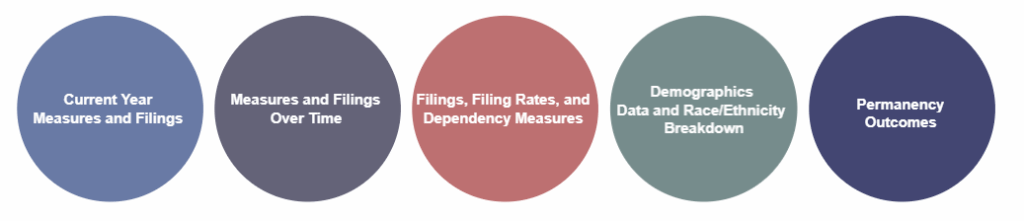
The dashboard provides the public data in five main areas:
- Current year dependency timeliness measures updated on a monthly/quarterly basis.
- Measures and filings for prior years.
- Prior year filings and filing rates, and current year dependency measures.
- Race/Ethnicity data for prior years’ filings and measures by race/ethnicity, and filing rates by demographics for prior years.
- Permanency Outcomes by demographics, point-in-time median length of stay, and placement discharge type.
Interactive Dependency Timeliness Reports (iDTR)
Available to court users with Inside Court Access only
The Interactive Dependency Timeliness Reporting System (iDTR) is a web-based application, housed securely on an internal server at the Administrative Office of the Courts (AOC), which addresses the need for frequent and robust feedback to the field. The tool allows users to view data for the state, their own county, or any other county. Users specify data filter criteria and level of detail, allowing them to view data all along the spectrum from broad state-to-county or county-to-county comparisons, to case-specific information. It provides data that counties can use to manage, assess, and improve their court systems on a local level. Using data from iDTR and DCYF’s Famlink database, local jurisdictions identify issues where they can undertake measurable change efforts through targeted training and implementation. The iDTR allows FYJP, AOC, DCYF and local courts to operate from a common data source when making strategic decisions.
Link to Inside Courts: Extranet HomePage (wa.gov)

Learning Opportunities
Training Module
Designed for FJCIP Coordinators, this interactive online court module is designed to increase data capacity in dependency courts.
Dash Demo
Use the Dependency Dashboard (“Dash”) accessible to all individuals to review the dependency system data.
Odyssey Training
Created by AOC’s Court Education Department, this video shows how to use Odyssey for case management and data collection.
Tools & Resources
Data Mapping Tool
This tool provides the user a guide through the court data available for the dependency timeliness measures in Washington State.
FJCIP
State funded program that supports local efforts to reform and enhance court systems that manage family and juvenile cases.
Family Treatment Courts Data Resources
Resources designed to support data collection, evaluation and reporting within Family Treatment Courts.
Collaborative Courts Data & Research Resources
Data training and resources designed for use by Collaborative Court programs.
Resources for Data Entry
These resources are designed to support and improve entry of dependency court data.
Learn More
Most Superior Courts in Washington use some form of Odyssey. Help.courts.wa has resources for you on how to use the many functions of Odyssey. Check out their page for training material, videos, and manuals: Help.Courts.Wa.Gov
Additional resources available on inside.courts.wa.gov include the County Clerk’s Handbook and the Superior Court Statistical Reporting Manual
Here are some tailored explanation sheets designed to help you create your own local processes for data entry.
Pattern Forms
The standard court forms and format rules created for mandatory use by parties in dependency matters in WA.
Learn More
The administrative office of the courts collaboratively develops standard court forms and format rules for mandatory use by parties in dependency matters according to RCW 13.34.035. Mandatory forms are accessible to all through Courts.wa.gov Washington State Courts – Court Forms – Dependency Proceedings.
Dependency data relies on codes entered into the court systems off orders and hearing type codes. The codes are designed to work with pattern forms. The pattern forms are designed to meet format rules and the requirements by the clerk’s office for entry of the codes. Learn more about how these codes are used in different areas of the data through the FJCIP Data Mapping Tool.
Customizable Templates
Download customizable templates for reporting and displaying dependency court data.
Learn More
FJCIP Example Report Template
The FJCIP Example Report Template was developed to familiarize courts with the available data specific to Washington. This guide assists in understanding data access points and facilitates data analysis for the purpose of community engagement and enhancing system improvement efforts. Additionally, the template is customizable at the local level, allowing you to create a tailored report that meets the unique needs of your local county.
DOWNLOAD EXAMPLE REPORT TEMPLATE
Beyond the Numbers: A toolkit for FJCIP Coordinators in Writing Quarterly Reports
The tips sheet was designed to assist you in writing effective reports for dependency courts. It provides guidance on tailoring your reports to local communities. For more detailed insights, explore the ideas shared here.
Case Flow Example
The example of case flow mapping for dependency courts was created to support local courts in individualizing their court process.
Learn More
The example County Dependency Case Flow Process for dependency courts was created to support local courts in individualizing their court process, while creating a structure that includes the needed data entry points for accurate dependency data.
The tool outlines hearing codes and orders that house the needed codes for your dependency data. We encourage you to work with your cross-system partners to develop a process that works for your local system.
To receive a customizable copy of the County Dependency Case Flow Process please contact Rosalynn Guillen at rosalynn.guillen@courts.wa.gov
Early Childhood Courts Data Resources
Resources designed to support data collection, evaluation and reporting within Early Childhood Courts.
Shelter Care Court Observation Tool
Tool created to evaluate judicial and court practice in observations of Shelter Care Hearings.
SB 6068 Legislative Report
Summarizes the engagement process, results, and recommendations for conceptualizing and strategizing the use of data to support relational permanency and child well-being.